India's First Unified National Membership Platform - India's FirMembership Platform - India's First National Membership Platform - India's First Unified National Membership Platform
A Planet Waiting For Us !?
Could Another EARTH exist somewhere ?
If Yes, What Would You Name It . . .
- Pratyusha Magdum
Imagine looking up at the night sky and realizing that somewhere, far beyond the stars we can see, there could be another planet just like Earth. A planet with oceans, mountains, rain, and maybe even life. It sounds like science fiction, but scientists have actually discovered thousands of planets outside our solar system, known as exoplanets.
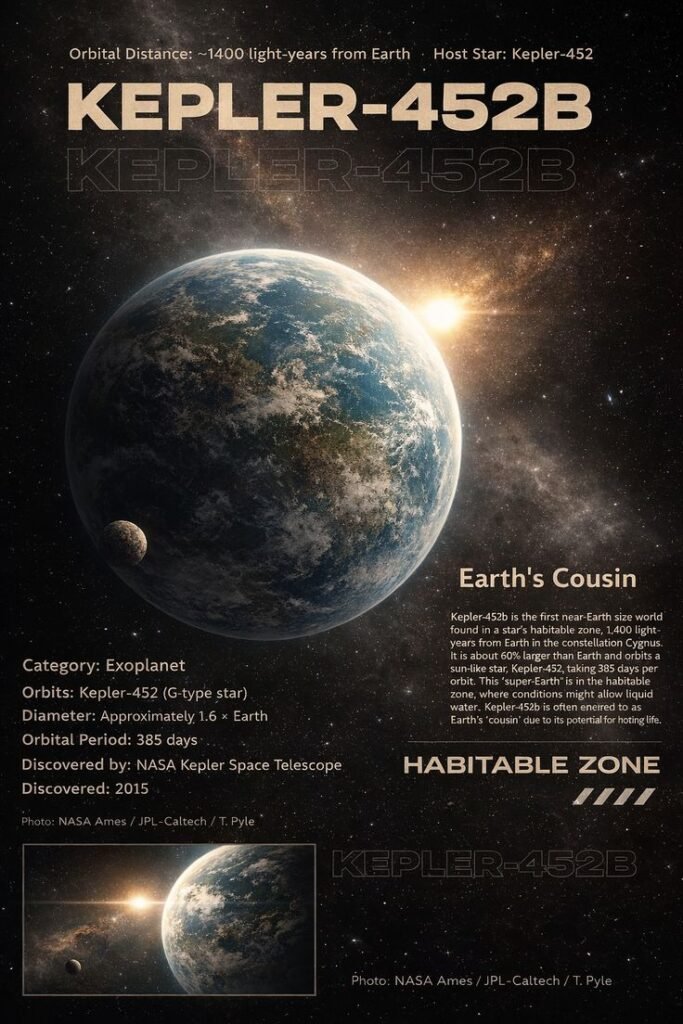
Kepler-452b and the Possibility of Life Beyond Earth
Over the past few decades, space exploration has entered a completely new era. Advanced telescopes and space missions have allowed scientists to detect planets orbiting distant stars across the galaxy. These discoveries have changed the way humanity views the universe and raised one of the biggest questions in science: are we alone?
Some of these planets are located in what scientists call the “habitable zone,” meaning they are at the right distance from their star for liquid water to exist. Since water is one of the most important requirements for life, scientists believe these planets could possibly support living organisms. The habitable zone is often called the “Goldilocks Zone” because conditions are not too hot and not too cold — just right for life as we know it.
One of the most fascinating discoveries is Kepler-452b, often called Earth’s “older cousin.” It is a super-Earth exoplanet located around 1,800 light-years away in the constellation Cygnus. What makes this planet so special is that it orbits a star very similar to our Sun and lies within the habitable zone.
Kepler-452b is around 60% larger than Earth and is estimated to be nearly five times more massive, placing it in the category of “super-Earths.” Surprisingly, it takes about 385 days to complete one orbit around its star, which is very close to Earth’s 365-day year. Its host star is also similar to the Sun but much older, estimated to be around 6 billion years old.
Scientists believe that because the star is older, Kepler-452b may have experienced billions of years of environmental and atmospheric changes. If life ever developed there, it could theoretically be far older than life on Earth. This possibility makes the planet extremely interesting for researchers studying astrobiology and planetary evolution.
Because of its position in the habitable zone, scientists believe liquid water could possibly exist there. However, life on Kepler-452b may not be easy for humans. Due to its larger size and mass, the planet’s gravity could be more than twice as strong as Earth’s, making movement and exploration extremely difficult. Humans would weigh much more there, and even simple activities could require enormous physical effort.
Another major challenge is distance. Kepler-452b is located nearly 1,800 light-years away from Earth. To understand how far that is, one light-year equals about 9.46 trillion kilometers. Even with the fastest spacecraft humans have built so far, reaching the planet would take millions of years. This shows how limited current space travel technology still is.
Despite these challenges, scientists continue searching for Earth-like worlds using advanced technologies. Space telescopes such as the NASA Kepler Space Telescope and the James Webb Space Telescope are helping researchers analyze distant planets and study their atmospheres. Scientists look for gases like oxygen, methane, carbon dioxide, and water vapor because these could indicate the possibility of life.
Artificial intelligence and machine learning are also becoming important tools in space research. These technologies help scientists process massive amounts of telescope data and identify planets that may have Earth-like conditions. As technology improves, discoveries that once seemed impossible are becoming more realistic.
The discovery of exoplanets has not only expanded scientific knowledge but has also inspired global interest in astronomy, space exploration, and the future of humanity. Some scientists even believe that one day humans may need to find another habitable planet due to environmental challenges, overpopulation, or the long-term survival of civilization.
Even though planets like Kepler-452b seem promising, discovering another true “Earth” is still a huge challenge. Many exoplanets have extreme temperatures, toxic atmospheres, or conditions that humans could never survive in. Finding a planet that perfectly matches Earth’s atmosphere, gravity, climate, and ecosystem remains one of the greatest goals in modern science.
Still, the search continues. Every new discovery helps scientists understand more about the universe and humanity’s place within it. The possibility that another Earth may exist somewhere among billions of stars continues to inspire curiosity, innovation, and exploration across the world.
As scientists continue exploring deeper into space, one exciting question remains: could another Earth really exist somewhere out there — waiting to be discovered?
The Future of Human Exploration Beyond Earth
Humanity has always been driven by curiosity and the desire to explore the unknown. From discovering new continents on Earth to landing on the Moon, every generation has pushed the boundaries of exploration further than ever before. Today, scientists and space agencies around the world are focused on the next great challenge — exploring planets beyond our solar system and searching for another habitable world.
The discovery of exoplanets has transformed modern astronomy. Thousands of planets have already been identified orbiting distant stars, and many of them exist in conditions that may support life. These discoveries have sparked global interest in the possibility that humans may one day travel beyond our solar system or even establish settlements on distant planets.
One of the biggest reasons scientists are studying Earth-like planets is the long-term survival of humanity. Earth currently provides everything humans need to survive, including oxygen, water, food, and a stable climate. However, concerns such as climate change, resource depletion, natural disasters, and population growth have encouraged scientists to think about the future of human civilization beyond Earth.
Planets such as Kepler-452b have become important subjects of research because they may possess conditions similar to Earth. Although these planets are incredibly far away, they provide scientists with valuable information about how planets form, evolve, and potentially support life.
Modern space exploration is advancing rapidly with the help of innovative technologies. Powerful telescopes such as the James Webb Space Telescope are allowing scientists to study distant planets in greater detail than ever before. Researchers can now analyze atmospheric gases, temperatures, and planetary compositions to determine whether a planet could support life.
Private space companies are also playing a major role in shaping the future of exploration. Companies like SpaceX are developing reusable rockets and advanced spacecraft designed to make space travel more affordable and efficient. Scientists believe that technological breakthroughs in propulsion systems, artificial intelligence, robotics, and energy systems may eventually make interstellar exploration possible.
Despite these advancements, enormous challenges still exist. The distances between stars are so vast that traveling to nearby exoplanets with current technology would take thousands or even millions of years. Human survival during long-duration space travel also presents major difficulties, including radiation exposure, limited resources, and the physical and psychological effects of living in space for extended periods.
Another important area of research involves the search for extraterrestrial life. Scientists are studying whether microbial organisms or intelligent civilizations could exist elsewhere in the universe. The discovery of even simple life beyond Earth would completely change humanity’s understanding of biology, evolution, and our place in the cosmos.
The future of space exploration is not just about science , it is also about inspiration, innovation, and the future of human civilization. Every new mission encourages technological development, international collaboration, and scientific discovery. Space research has already contributed to advancements in communication, medicine, engineering, and computing technologies used in everyday life.
As humanity continues to look toward the stars, the dream of discovering another Earth remains one of the greatest ambitions in modern history. While humans may still be far from reaching distant exoplanets, each discovery brings us one step closer to understanding whether life exists beyond our world.
The universe is vast, mysterious, and filled with possibilities. The question is no longer whether exploration will continue , it is how far humanity is willing to go in the search for another home among the stars.
KEPLER-452b:
Too Far to Call Home?
Among the thousands of exoplanets discovered by scientists, Kepler-452b stands out as one
of the most fascinating. Often called Earth’s “older cousin,” this super-Earth is located nearly
1,800 light-years away in the constellation Cygnus within the Milky Way galaxy. Scientists
became interested in the planet because it orbits Kepler-452, a Sun-like star that is estimated
to be around 6 billion years old. The planet also lies within the habitable zone, where
temperatures may allow liquid water to exist.
Kepler-452b is around 60% larger than Earth and is believed to be nearly five times more
massive. It takes approximately 385 days to complete one orbit around its star, making its
year very similar to Earth’s. Because of these similarities, scientists consider it one of the
strongest candidates for a potentially habitable world beyond our Solar System.
What makes Kepler-452b especially interesting is the possibility that it could have rocky
surfaces, oceans, or even an atmosphere capable of supporting certain forms of life. Some
scientists believe that if life exists there, it may have had billions of years more than Earth to
develop and evolve because the planet’s star is older than our Sun. This idea has made
Kepler-452b one of the most discussed exoplanets in modern astronomy.
However, despite these promising features, humans may not be able to live on Kepler-452b.
Due to its massive size, the planet’s gravity could be more than twice as strong as Earth’s,
making movement and survival extremely difficult for humans. Walking, carrying
equipment, or even standing for long periods could become physically exhausting under such
powerful gravity.
Scientists also do not know whether the planet contains breathable oxygen, safe temperatures,
or a stable atmosphere necessary to support life. The atmosphere could potentially contain
harmful gases or experience extremely high pressure levels unsuitable for humans. In
addition, harsh environmental conditions such as powerful storms, volcanic activity, or
dangerous radiation may exist on the planet.
Another major obstacle is distance. Since Kepler-452b is around 1,800 light-years away,
traveling there with current technology would take millions of years. Even the fastest
spacecraft ever created by humans would not be capable of reaching the planet within a
human lifetime. This makes exploration incredibly difficult and highlights the limitations of
present-day space travel.
Scientists discovered Kepler-452b using NASA’s Kepler Space Telescope, a mission
designed to search for planets outside our Solar System. The telescope detects exoplanets by
observing tiny decreases in a star’s brightness when a planet passes in front of it. This
discovery marked an important achievement in the search for Earth-like planets and expanded
our understanding of the universe.
Even though the planet appears to be one of the closest examples of an Earth-like world, it
remains too far and too challenging for humans to call home. Still, discoveries like Kepler-
452b continue to inspire scientists and strengthen the search for another habitable planet
beyond Earth. It reminds humanity that the universe is far larger and more mysterious than
we can imagine, and somewhere among the stars, another Earth may still be waiting to be
discovered.
